
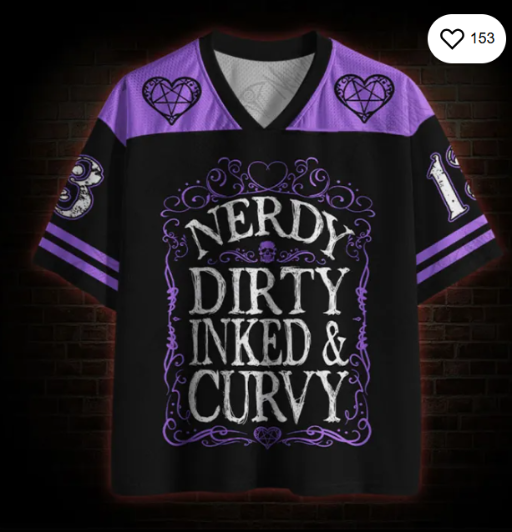
Walk the floor of any mid-sized convention in August and count the mesh jerseys. Five years ago you’d have spotted a handful, mostly sports fans in team colors. Now they’re everywhere, and the graphics have nothing to do with sports. Slasher villains. Pixel-art bosses. Occult sigils. The mesh jersey has become the unofficial summer top of fandom culture, and it happened fast enough that plenty of people are still asking how.
There’s no single cause. It’s a mix of fabric, nostalgia, price, and a shift in what “wearing your fandom” means. Let’s take those one at a time.
The fabric problem that graphic tees never solved
Cotton graphic tees have been the default fan merch for decades. They’re also miserable in real heat. Cotton absorbs sweat, holds onto it, and then clings. Anyone who’s stood in a two-hour signing line in a black cotton shirt knows exactly what this feels like.
Mesh polyester works differently. The open weave lets air move through, the fibers don’t absorb moisture, and the whole thing dries in minutes instead of hours. That’s a functional advantage, not a style one, and it’s the reason the jersey format was adopted by athletes in the first place. Fans just borrowed the tech.
How did sublimation printing change the game?
Old jerseys had names and numbers stitched or heat-pressed onto plain fabric. That worked for a team logo. It didn’t work for a full-color painting of a haunted house.
Dye-sublimation changed that. The design is printed onto transfer paper and then heat-bonded into the polyester itself, so the color becomes part of the fiber. Edge-to-edge artwork is possible, gradients look clean, and there’s no thick plasticky layer to crack or peel. Suddenly a jersey could carry the same kind of detailed art that had been limited to posters and prints.
Small independent brands jumped on this. A nerdy mesh jersey covered in Lovecraftian tentacles or a retro arcade motif costs roughly the same as a licensed band tee, and it photographs far better. For a generation that documents outfits on camera by default, that matters more than it used to.
Nostalgia did the rest
The jersey’s second life in streetwear started in the late 1990s. Basketball jerseys over white tees, worn with baggy denim, were a defining silhouette of the era. Skate culture picked it up. Hip-hop kept it alive through the 2000s.
That’s the exact window a lot of today’s con-goers grew up in. The oversized jersey feels familiar in the way a certain Saturday morning cartoon feels familiar. Wearing one with a horror print merges two nostalgias at once: the clothing of your childhood and the media you loved during it.
It’s cheaper than cosplay and easier than a costume
Full cosplay is expensive, hot, and hard to sit down in. A lot of people who love a franchise just want a low-effort way to signal it for a day without spending a weekend gluing foam.
A jersey threads that needle. It’s clearly a fan garment, it’s comfortable for twelve hours, and you can wear it again at a barbecue the following week. One con attendee I spoke with described her cryptid jersey as “cosplay for people who still want to eat lunch.” That’s about right.
Gaming culture pushed it over the edge
Esports teams adopted the jersey format early, partly because it mirrored traditional sports and partly because it’s what streamers could actually wear on camera for hours. When professional gaming looks like this, casual gaming follows.
Then the indie graphic brands realized they didn’t need a team at all. A jersey with a pixel-art design or a 404-error joke on the back does the same cultural work as a team kit, minus the team. It says “I’m part of this” without requiring anyone to pick a side.
Why the horror crowd in particular?
Horror fans have always leaned into visual identity. Band-shirt culture and horror culture overlap heavily, and both communities are used to wearing dark, graphic, slightly confrontational imagery. The jersey’s large printable surface is basically a wearable poster.
Summer is also, oddly, horror’s season. Slasher films are set at summer camps. Drive-in horror marathons happen in July. The genre has a warm-weather identity that most people don’t notice until they think about it.
Is this a fad or a permanent shift?
Fads usually depend on one trend cycle. This one rests on a practical advantage (breathability), a technical enabler (sublimation), a nostalgia hook (90s streetwear), and a cultural home (fandom). Remove any one and the others still hold.
What will probably change is the silhouette. Cropped jerseys, off-shoulder cuts, and long-sleeve V-neck versions are already spreading, which suggests the format is diversifying rather than fading. The same brands are extending the idea into cold-weather knits too, so a summer jersey wearer can slide into nerdy cardigan sweaters come October without leaving the aesthetic behind. That’s the pattern of something settling in.
What this means if you’re shopping
- Check the printing method. Sublimated designs outlast screen prints on mesh by years.
- Read the size chart. Jerseys designed for streetwear often run intentionally oversized.
- Buy the design you’d actually want to explain to a stranger, because someone will ask.
The mesh jersey earned its place through function first and fashion second. Whatever replaces it will need to beat both, and nothing has yet.