
Doomscrolling is designed to hijack your brain and put it in survival mode by feeding it with infinite content. Your brain then takes it as a potential threat and convinces you to keep scrolling to stay safe.
It’s 9:30 in the evening in Austin, and you’re trying to eat dinner while scrolling on your phone. You open one meme after another, and next thing you know it’s 3 a.m., and you are on your phone on a weekday. Thanks to fast, reliable 5G home internet in Texas, streams load instantaneously, eliminating the loading screens that usually serve as a reality check.
Regret kicks in, and now you want to know what went wrong?
Was I too bored, or do I have no self-control?
Well, endless feed scrolling is actually not under your control.
Yes, you read it right. Your social media algorithm is designed to keep you chronically online and obsessively scrolling through the content. It is addictive, and getting out of its grip might even make you feel exhausted and anxious.
So, how does doomscrolling keep your mind trapped, and how do you get out of its grip? Here is everything you need to know.
Why Is Doomscrolling So Addictive?
The human mind has survival alarms. It can detect both bad and good news, but over the years, it has evolved to prioritize bad news over good. Blame it on the survival-of-the-fittest instinct or living under years of potential danger; our mind is very sensitive to a bad environment.
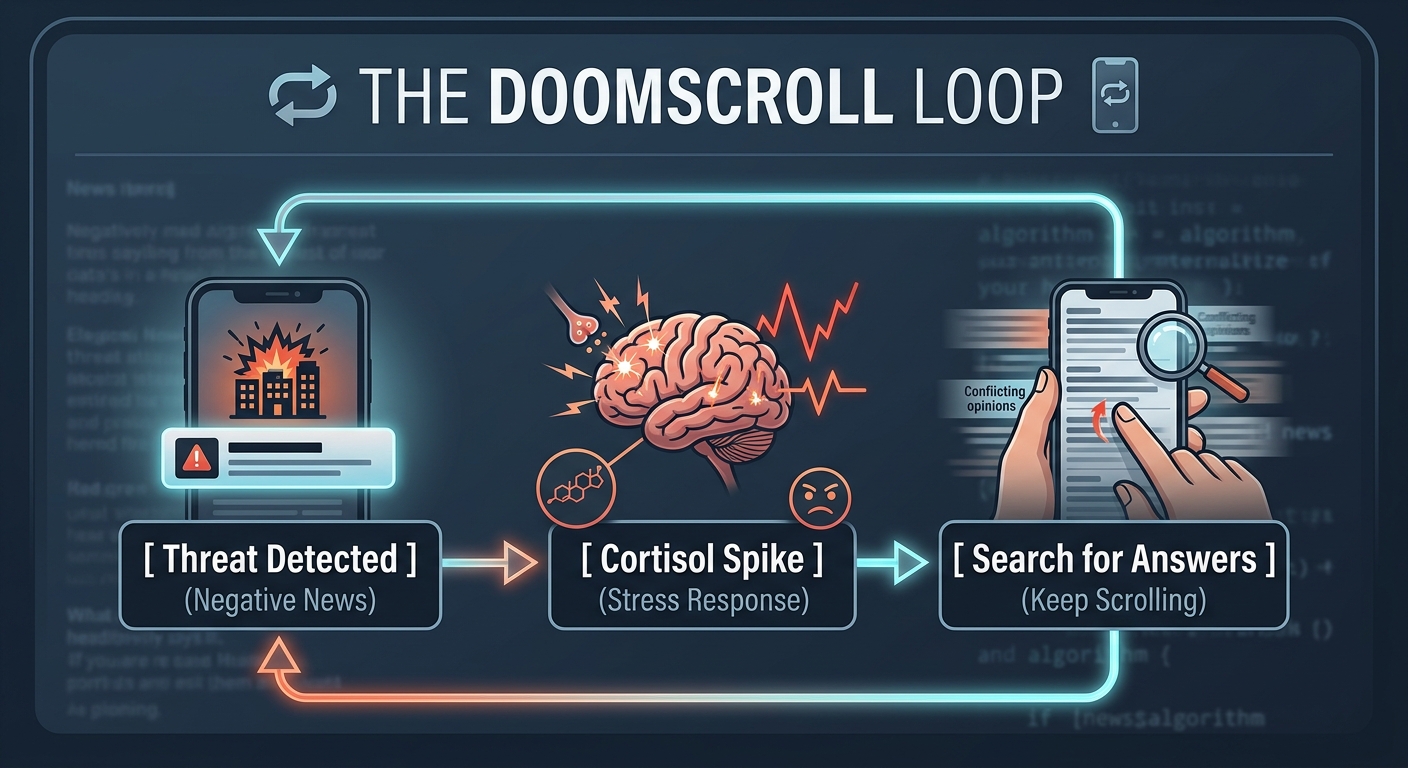
This sensitivity is keeping us alive and away from potential threats. Scientists call this preference negative bias. When the brain gets into a stressful situation, it alarms your whole body, and it forgets everything else. For instance, you come across a news headline; your brain triggers the stress hormone (cortisol), and it then gets you to find ways to protect yourself.
Here is a blueprint of how negative bias is linked with doomscrolling:
How Does the Algorithm Get Us to Doomscroll?
Once you get on social media and start watching content, your survival instinct kicks in. It builds a trap for your brain so it can seek comfort by watching more content.
This is called a variable reward schedule. Short-form content platforms like TikTok, X, and Instagram rely on this psychological mechanism. It makes doomscrolling as addictive as gambling. Your brain feels like social media is a slow machine that will give you comfort and entertainment once you invest a bit of time.
Here are different phases of doomscrolling and their impact on the brain:
You start scrolling; it triggers dopamine, and you feel joy.
You then get into the infinite scrolling loop, which pushes your brain to eliminate any natural stopping point. Your brain feels that if it reaches the end of scrolling, it might miss something very important.
Then comes the variable reward point. Your brain seeks reward and enjoys the unpredictability behind it. It has no idea if the next video will be funny, terrifying, or informative. It focuses on the uniqueness of every video and feels joy.
This also makes the brain crave the dopamine spike, so it keeps scrolling, and you feel your thumb moving unintentionally.
But what happens when you keep scrolling but you don’t get the dopamine spike?
Well, sometimes you do come across something that does make you laugh; maybe it’s boring, or even content that you have already watched. Well, then your brain anticipates more fun content and even waits for ten more stressful posts just to get to the fun post that can trigger the reward mechanism.
How To Break the Doomscrolling Habit?
The good news is that you can actually train your brain to stop scrolling. These strategies are simple, practical, and can help you regain your focus:
Creating A Break Time
The idea is to create friction and stick to a 20-second rule.
How can you do that?
Well, your goal is to make access to social media a little harder for yourself. You can either block the app during work hours, put it in a hidden folder, add extra security to it, or just keep your phone a little farther away. When you have to put a few extra seconds just to access the phone or the app, the effort will increase, and your brain will not be on autopilot.
Create Physical Boundaries
This is an ideal remedy for families with kids. The idea is to either create a dedicated area to put your phone or at least keep the charger away. Through this strategy, you will eliminate your phone from the places you use most often, i.e., the bedroom, living room, and kitchen. Additionally, it will help you to avoid late-night scrolling.
Get Rid of Colors
Colors are attractive; they trigger emotions, get you hooked, and make you feel happy. However, when you get rid of all the vibrant colors on the screen, your brain will register it as a black-and-white newspaper, which will be less appealing and addictive.
Stay Occupied
Boredom is one of the biggest reasons most people start scrolling on their phone. So, make sure you stay occupied; don’t sit idle and fill that void with something productive. It can be a book, a puzzle, or a painting.
If you find yourself doomscrolling next time, don’t just beat yourself up; instead, try the above-mentioned strategies to stay occupied and keep the phone away.