

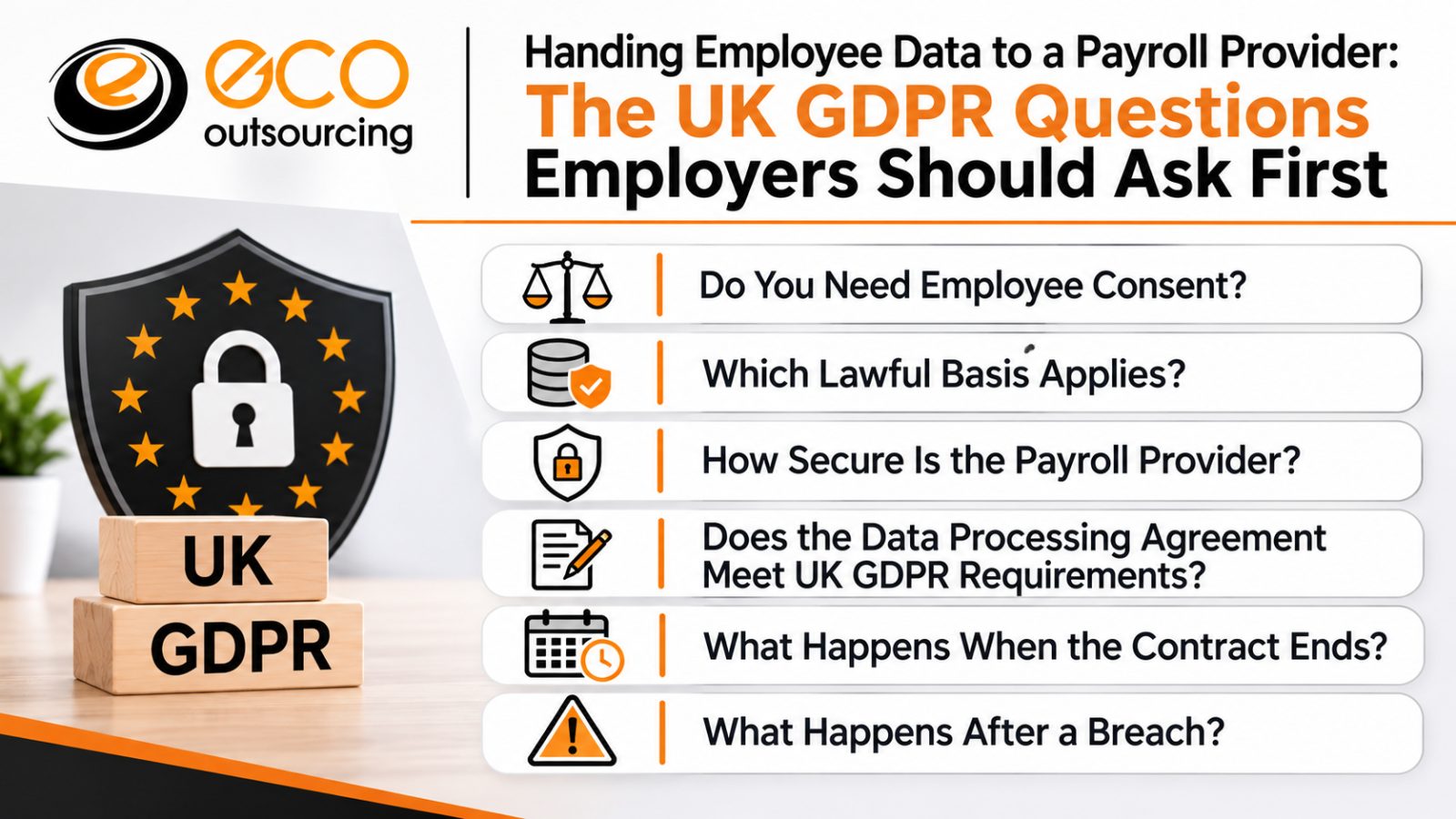
Payroll means trusting someone with salaries, bank details, National Insurance numbers and tax codes. Hand that to a payroll outsourcing company and you’ll want to know exactly where it goes and who can see it. That’s a sensible instinct. Saves hours of admin headaches… if you know how the process works.
This guide will explain what you need to look for, who is responsible for what, questions to ask and what to do when problems occur. There’s even a checklist at the end here to help with your next outsourcing provider meeting.
What Employee Information Does a Payroll Provider Need?
Less than you might think. To pay people correctly, a provider needs names, contact details, National Insurance numbers, bank details, pay, tax codes, pension contributions, hours, and start and leaving dates. It doesn’t need your whole HR file.
That’s data minimisation: share only what the job requires.Ask why they are requesting this
Health data should be treated carefully. This is classed as special data under UK GDPR payroll rules, meaning there must be an additional lawful reason for processing this data. For statutory sick pay all they require are dates and if you are eligible, not a diagnosis.
|
Information |
Why it’s needed |
What to check |
|
National Insurance number |
PAYE administration |
Restricted access |
|
Bank details |
Paying employees |
Verification and access controls |
|
Salary |
Pay calculations |
Confidentiality |
|
Pension details |
Contributions |
Only relevant data shared |
|
Sickness information |
Sick pay |
Medical detail excluded |
Who Is Responsible Under UK GDPR?
Outsourcing a service is often assumed by many employers to transfer this responsibility. However, you will normally be the data controller. This is where you decide why and how employee data will be used. The service provider will normally be the data processor. They carry out actions based on your documented instructions. The roles are determined by the actions carried out by the parties rather than the titles they are given in the contract.
Picture a payroll data breach at the provider that exposes your staff’s bank details. The provider must tell you without undue delay. You then assess the risk and decide who to notify. You remain accountable throughout.
Do You Need Employee Consent?
Not typically. There is a lack of parity in the relationship between an employer and employee. Employees have the ability to revoke consent. Employers are therefore more likely to rely on legal basis or legitimate interests, depending on what the task is. Explain why.
Employees should still be aware of what will happen to the data they provide. Update your privacy notice to include details of the role of the provider, the purpose and sharing.
What Should the Data Processing Agreement Say?
Article 28 of UK GDPR requires a written contract with any processor. A generic service agreement often won’t cover it. A proper payroll data processing agreement should set out:
- Purpose and duration of processing
- Types of data and categories of employees
- Processing only on your documented instructions
- Confidentiality obligations
- Security measures
- Rules on sub-processors
- Help with employee data rights
- Breach notification and cooperation
- Return or deletion of data at the end
- Audit and inspection rights
Don’t skip the audit clause. A verbal assurance that “we take security seriously” proves nothing.
How Do You Check a Provider’s Security?
Access controls – only payroll personnel should have access. This can be done by requiring individual login details, role based access and keeping audit trails.
Protection encryption, multi-factor authentication, secure portals and regular backups. How are changes to bank details verified? Criminals love to target here!
Request security policies, staff training details and incident response plans. ISO 27001 is reassuring, yet it doesn’t prove compliance with every UK GDPR requirement.
A UK address doesn’t settle it either. Registered office, hosting location and staff access locations are three different questions. Overseas access isn’t automatically unlawful, but any payroll data transfer abroad needs adequacy regulations or proper safeguards. Ask for the list of payroll provider sub-processors, such as cloud hosts and IT support, and how you’ll hear about changes.
What Happens After a Breach?
Your provider will investigate the incident and will advise you quickly. You will then need to decide whether to report to the ICO. Where possible you should report the breach within 72 hours of becoming aware unless it is unlikely to pose a risk to individuals. If there is a high risk to individuals then you should notify the affected employees.
Agree how you will notify them initially, within how long and what information they will receive.
When leaving a provider you should be confident that you will be able to securely return employee payroll information, access previous payslips, remove access from your former provider and confirm that they have been deleted. You should also ensure that you have backups. Employees may wish to perform subject access requests so your provider should support you to locate records quickly.
Ten Questions to Ask Before You Sign
When comparing any payroll outsourcing company, take this list into the meeting.
- What data do you need from us? Expect a short, justified list.
- Why do you need each category? Every item should tie to a payroll task.
- Will you act as our processor? The answer should be a clear yes.
- Can we review your Article 28 agreement? They should share it readily.
- Where is data stored and accessed? Expect specific locations, including support teams.
- Do you use sub-processors? Look for a named list and change notifications.
- What security protects our data? Concrete controls beat reassurance.
- How fast will you report a breach? Ask for a defined timeframe.
- How will you help with data requests? There should be a set process.
- What happens when the contract ends? Look for secure return and written confirmation of deletion.
Frequently Asked Questions
Can we outsource payroll processing without consent of all employees?
This is usually possible. Consent is not typically the lawful basis. Select an appropriate lawful basis and include a reason. It should also be outlined within your privacy notice what role the provider will have.
Will we be liable under the UK GDPR?
No. You will still be the controller and are responsible for ensuring you are compliant. The payroll provider will be the processor and will have their own legal responsibilities.
Is it safer to use a UK based payroll provider?
Not necessarily. Just because they have a UK address does not mean that your data will be held in the UK. Find out where they host their data, where their support teams are based and any sub-processors they have.
What do we need to do if there is a data breach with our provider?
Find out the details of the breach. Assess the risk and report to the ICO within 72 hours if necessary. If there is a high risk, inform the affected employees.
Can we request our employee data back from our provider?
You should be able to. This should be covered within your contract that they must securely return or delete your data (including backups) in writing.
Conclusion
When you outsource payroll it still remains your responsibility to ensure employee data is protected. Limit the information that you provide, clarify who the controllers and processors are and ensure you understand the agreement.
Ensure they have good security measures by testing them, find out if they will have access to the data internationally and what happens at the conclusion of the contract. Whilst price is important, there is more to consider.
If you are looking to shortlist, Eco Outsourcing is definitely worth speaking to. They offer a payroll outsourcing service. To help you, ask them the questions in the checklist above. Just ask them simple questions around who will have access to the data, how it will be secured and what their responsibilities are.