
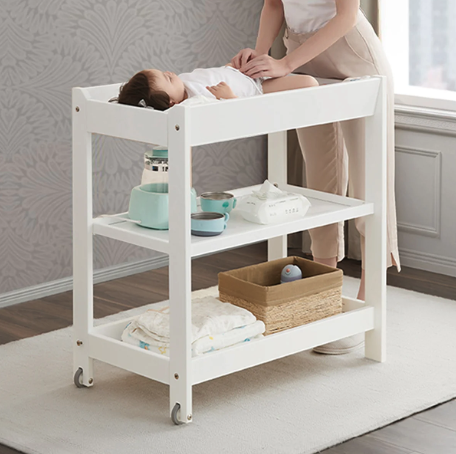
The baby changing table is the British nursery furniture piece that receives the highest frequency of daily use across the newborn period — 8 to 12 changes per day across the first year means the change surface accumulates 2,920 to 4,380 individual nappy change interactions before the British baby is twelve months old. This frequency makes the ergonomic specification of the change surface more consequential than British nursery advice typically acknowledges, and the non-toxic certification of the surface finish more immediately relevant than on any other British nursery furniture piece. This September, as British families set up autumn nurseries for winter births, this guide provides the most current and complete framework for the British baby changing table decision in 2026.
The British Changing Table vs Changing Dresser Decision in 2026
Should British autumn 2026 nursery families choose a dedicated changing table or a changing dresser?
The changing dresser has become the dominant British nursery choice in 2026 over the dedicated changing table for three practical reasons that the British autumn nursery context makes particularly compelling. First, the changing dresser provides both the change surface and full drawer clothing storage in one floor footprint, eliminating the separate chest of drawers that a dedicated changing table requires — a critical advantage in the compact British Victorian, Edwardian, and new-build nurseries where floor space is most constrained. Second, the changing dresser continues as the British child's bedroom chest of drawers for 10 to 15 years after the change mat is removed, providing the most cost-effective single nursery furniture investment per year of total service. Third, the changing dresser at the correct ergonomic height of 80 to 90 cm provides the change surface specification that the dedicated changing table is purpose-designed for — making it equivalent in ergonomic function at the superior total service value.
The Ergonomic Height: Britain's Most Important Changing Table Specification
What height prevents lower back strain for British parents during nappy changing?
The ergonomically correct baby changing table height for British parents positions the change mat surface at approximately elbow height when standing — typically 80 to 90 cm from the British floor for most adult heights. At this height, the British parent maintains a neutral spine during changes without the forward trunk flexion that lower surfaces require. A change surface below 75 cm forces excessive forward bending; above 95 cm creates shoulder elevation. Both produce cumulative musculoskeletal strain across the 2,920 to 4,380 change interactions of the first British year. British parents who measure the specific height from floor to change mat surface — not just the unit height — before purchasing avoid the ergonomic mismatch that a change mat of unexpected depth can create on a unit that appears to be at the correct height.
|
UK Changing Configuration |
Ergonomic Height |
Storage |
Post-Nappy Use |
2026 British Preference |
|
Dedicated changing table |
Purpose-designed: confirm 80-90cm |
Shelves only — requires separate chest |
Limited: 2-3 year service |
Declining: less practical for British nurseries |
|
Changing dresser (chest + mat) |
Confirm top at 80-90cm from UK floor |
Full drawers — complete nursery storage |
10-15 years as bedroom chest |
Growing: dominant British 2026 choice |
|
Changing topper on existing furniture |
Depends entirely on existing piece height |
None additional |
Not applicable |
Acceptable only if existing piece at correct height |
|
Wall-mounted fold-flat changer |
Fixed at installation height — plan carefully |
None |
Can be removed post-nappy stage |
Niche: suited to very compact British nurseries |
Non-Toxic Certification: The Most Relevant British Nursery Furniture Standard
Why is non-toxic certification most important on a British baby changing table?
The baby changing table is the British nursery furniture piece where the most chemically intimate and most frequent contact between the surface finish and human skin occurs. During each of the thousands of nappy changes across the first British year, both the parent's bare hands and the baby's bare skin contact the change table top, the change table sides, and the edges of the surface directly. This intensive contact makes named non-toxic certification of the surface finish more immediately relevant than the same certification on any other British nursery piece. OEKO-TEX Standard 100 or GREENGUARD Gold certification — with a specific certificate number available from the UK retailer on request — confirms the chemical safety of the specific finish at levels appropriate for this intensive mouthing and skin contact. General 'non-toxic' or 'child-safe' claims without a named certification body provide no verifiable assurance for British parents.
The Safety Rule That Cannot Be Overstated
What is the single most important safety rule for British baby changing table use?
Never leave a British baby unattended on the elevated change surface — not for a single moment, not for any reason. This rule applies from the first nappy change at home regardless of the baby's apparent immobility, because even newborn British babies can produce unexpected movements that result in rolling from an elevated surface without warning. Before placing the British baby on the change surface, every item needed for the complete nappy change — nappy, wipes, cream, spare clothing if needed — must be within arm's reach of the change surface. The need to leave the change surface during a change indicates a storage configuration problem that must be resolved before the next change. All accessible nappy supplies should be positioned in the top drawer or on an adjacent shelf within arm's reach from the change surface position.
Frequently Asked Questions
How long do British families use a baby changing table?
Most British families use the change surface actively for two to three years per child, from birth until toilet training is reliably established at approximately age two to three. A British changing dresser continues as a full chest of drawers for the primary and secondary school years after the change mat is removed — providing 10 to 15 years of total furniture service from the single nursery investment. A dedicated British changing table with no secondary function provides two to three years of service per child before becoming a storage or repurposing challenge.
Does a British baby changing table need to be near a sink?
No. Modern British nappy changing requires water only for rinsing reusable cloths — most British parents use disposable wipes for routine changes. A baby changing table positioned near a British bathroom sink is a convenience for water-based cleaning rather than a functional requirement. The more important proximity requirement is that all nappy supplies are within arm's reach of the change surface itself — regardless of the change table's position within the British nursery room layout.
What is the best change mat for a British changing table?
The best British baby change mat has a minimum 10 cm raised edges on three sides to provide partial containment during nappy changes, a waterproof surface that is wipeable after each change, a removable washable cover for hygiene maintenance, and dimensions that fit the specific British changing table top with minimal overhang. The change mat should not be positioned on any surface that is not at the ergonomically correct height of 80 to 90 cm from the British floor, regardless of how convenient an alternative surface may appear during the busy British newborn period.
Is a British baby changing table covered by the Consumer Rights Act 2015?
Yes. All baby changing tables purchased from UK retailers are covered by the Consumer Rights Act 2015, providing British consumers with the statutory guarantees of satisfactory quality, fitness for purpose, and matching the product description. For a quality British changing dresser purchased for a 10 to 15 year service period, the Consumer Rights Act 2015's reasonable service life expectation would support warranty claims for genuinely defective products beyond most manufacturer's warranty periods.
Final Thoughts
The British baby changing table decision in autumn 2026 is most effectively resolved by the changing dresser configuration that combines the ergonomic change surface at 80 to 90 cm height with long-service clothing storage, in a quality solid timber construction with named non-toxic certification appropriate for the most chemically intimate nursery furniture contact. British families can compare current UK baby changing options at boori.co.uk/collections/baby-changing