
After a storm, a fallen branch can look like a straightforward cleanup job. But once a limb is under tension, partially supported by another branch, or resting on uneven ground, cutting it can become considerably more complicated. The safest approach is not to start cutting immediately; it is to assess the situation, establish a work area, and decide whether the job is appropriate for a homeowner to handle.
For smaller, accessible branches, a battery powered chainsaw can be a practical tool for cleanup when used according to the manufacturer’s instructions and within the operator’s experience. Battery operation can simplify preparation, but it does not change the fundamental hazards associated with cutting wood.
A good workflow treats the job as a sequence: assess, isolate, prepare, cut only what is predictable, and stop when conditions exceed your skill level. That mindset is more valuable than simply having a powerful saw.
Start With a Hazard Assessment Before Picking Up the Chainsaw
The first step should always be an inspection from a safe distance. Fallen branches can conceal hazards that are difficult to recognize once you’re focused on making the first cut.
Look for:
- Branches suspended overhead or caught in another tree
- Broken limbs under tension
- Partially uprooted or leaning trees
- Power lines or utility equipment nearby
- Fences, vehicles, structures, or other property in the potential movement area
- Uneven, muddy, icy, or slippery footing
- Nails, wire, fencing, or other embedded objects
OSHA’s chainsaw safety guidance specifically emphasizes clearing obstacles, identifying overhead hazards, maintaining secure footing, and planning the work area before cutting.
If the fallen material is connected to a damaged standing tree, suspended above the ground, or close to electrical lines, the situation is no longer a routine branch-cleanup project. Professional tree-care assistance is the safer choice.
Decide Whether the Branch Is Actually Suitable for Homeowner Cleanup
Size and Position Matter More Than the Number of Branches
A pile of small limbs may be manageable, while a single large branch can present significant risk. The question is not simply, “Can my saw cut this?” It is, “Can I predict what this piece of wood will do when it is cut?”
Homeowners should be particularly cautious with:
- Large limbs supporting significant weight
- Sections trapped beneath another log
- Wood that is bent or visibly compressed
- Branches attached to partially fallen trees
- Material resting across slopes or unstable ground
- Trees or limbs that could roll after being cut
The U.S. Forest Service emphasizes evaluating the cutting area, identifying hazards, and establishing escape routes before chainsaw work. (US Forest Service)
A chainsaw’s cutting capacity should never be the deciding factor by itself. Predictability is the more important measure.
Prepare the Work Area Before Starting the Battery Powered Chainsaw
Clearing the Workspace Makes the Cutting Sequence More Predictable
Once you’ve decided the material is appropriate for homeowner cleanup, prepare the surrounding area.
Move unnecessary people, pets, tools, and equipment away from the immediate work zone. Remove loose debris that could interfere with your footing or movement. Establish a clear route for stepping away from the material if it shifts unexpectedly.
Never assume a fallen branch is completely stable simply because it is already on the ground. Logs can roll, branches can spring upward, and sections under compression can move suddenly when released.
OSHA recommends identifying and clearing obstacles that could interfere with cutting or movement paths and stresses the importance of secure footing. (OSHA)
Inspect the Saw and Protective Equipment Before Making the First Cut
A safe workflow includes an equipment check before the saw reaches the wood.
Inspect the chain, guide bar, controls, handles, chain brake, and other safety components according to the manufacturer’s instructions. A dull or improperly maintained chain can make cutting less predictable because the operator may be tempted to force the saw through the material.
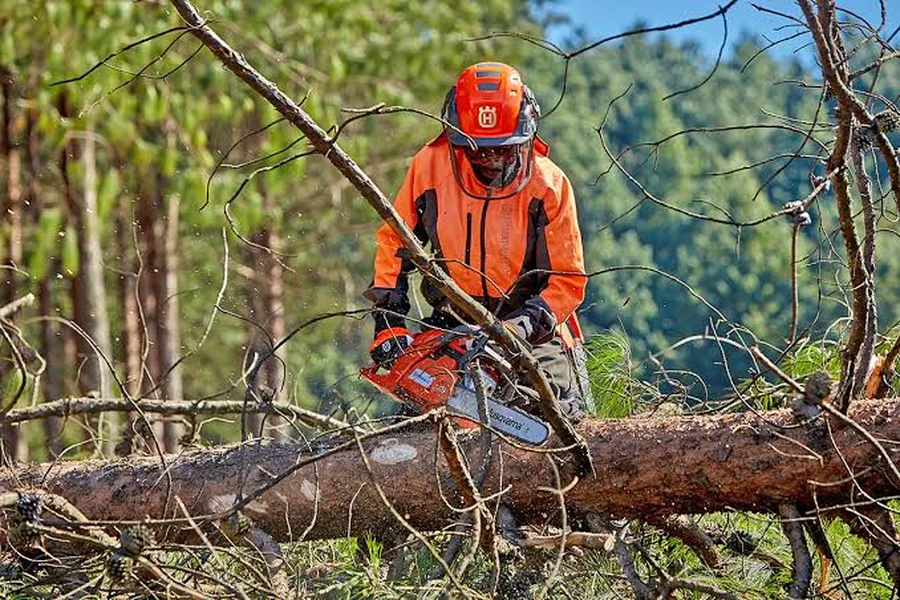
Personal protective equipment should also match the task. Eye protection, hearing protection where appropriate, sturdy footwear, gloves suitable for the work, and protective clothing are important considerations. Chainsaw-specific protective equipment may be warranted depending on the job and equipment being used.
OSHA’s guidance recommends checking controls, chain tension, bolts, handles, and safety devices before operation and stresses following the manufacturer’s operating instructions. (OSHA)
Understand Why Fallen Branches Can Move Suddenly During Cutting
Tension and Compression Are the Hidden Problems in Storm-Damaged Wood
One of the most important concepts in fallen-branch cleanup is that wood can behave differently depending on where its weight is being supported.
A branch lying across another object may be compressed on one side and under tension on the other. Cutting through the wrong location can cause the material to shift, roll, spring, or pinch the saw.
This is why homeowners should avoid treating every fallen limb as ordinary firewood.
If you cannot confidently determine how the branch is loaded or how it will move once cut, stop. The risk is not worth learning through trial and error.
Use a Simple Workflow Instead of Improvising From One Cut to the Next
A useful approach is to separate assessment from cutting.
Step 1: Identify the Stable Sections
Look for portions of the branch that are resting securely and are unlikely to move when separated.
Step 2: Identify the Unstable Sections
Mark mentally where the branch is supported, bent, suspended, or interacting with another object.
Step 3: Plan the Removal Sequence
Think about what will happen after each section is separated. The objective is to avoid creating a heavier or less stable piece as you work.
Step 4: Maintain a Clear Position
Never position yourself where a rolling, shifting, or springing section could move toward you.
Step 5: Stop and Reassess After Major Changes
Once a section has been removed, the remaining wood may behave differently. Do not assume the original assessment still applies.
This method may seem slower, but it prevents a common mistake: becoming so focused on the cut that the operator stops monitoring the entire work area.
Compare Small Limb Cleanup With Higher-Risk Tree Work
Not every fallen-wood project belongs in the same category.
| Situation | Homeowner Approach |
| Small branch lying securely on level ground | May be suitable with proper training and equipment |
| Several loose small limbs after a storm | Generally easier to manage systematically |
| Large branch under visible tension | Requires significant caution and experience |
| Partially uprooted tree | Professional assessment recommended |
| Suspended or hung-up limb | Do not improvise |
| Material near power lines | Keep clear and contact the appropriate professional |
| Cutting above shoulder height | Avoid |
OSHA specifically warns against cutting directly overhead and identifies hazardous operations such as work involving unstable trees, steep slopes, heavy lean, or other conditions beyond the operator’s capabilities. (OSHA)
Make Cleanup More Efficient by Separating Cutting From Debris Handling
A common mistake is trying to cut, drag, stack, and dispose of material simultaneously. That creates unnecessary movement around an operating saw.
Instead, establish a workflow in stages:
- Assess the entire area.
- Remove only manageable sections.
- Shut down or secure the saw before moving material.
- Create a separate pile for branches and logs.
- Return to cutting only after the work area remains clear.
This separation reduces clutter around the cutting zone and makes it easier to maintain secure footing.
It also prevents the common temptation to carry a running saw simply because the next cut is only a few feet away. OSHA guidance calls for the saw to be shut off or the chain brake engaged during appropriate carrying situations.
Avoid These Common Mistakes When Cutting Fallen Branches
Starting With the Most Difficult Piece
The largest or most complicated branch is not necessarily the best place to begin. Start by understanding the site and removing only material whose behavior is predictable.
Standing on the Branch While Cutting
A branch can shift as its weight changes. Stable footing should come from the ground or another secure surface, not from the material being cut.
Working Alone
Chainsaw work carries enough risk that having another person nearby is a sensible precaution. OSHA’s chainsaw safety fact sheet specifically advises against working alone.
Cutting Without Looking Above You
Storm damage can leave additional branches hanging overhead. A ground-level branch may not be the only hazard.
Treating a Partially Fallen Tree Like Firewood
A tree that has fallen against another tree or remains attached to its root system can behave unpredictably. These situations are better left to trained professionals.
Practical Best Practices for Safer Homeowner Woodcutting
A few habits make a significant difference:
- Read the saw’s operating and maintenance instructions before use.
- Wear appropriate protective equipment.
- Inspect the cutting area from multiple angles.
- Keep people and pets outside the immediate work zone.
- Maintain secure footing throughout the job.
- Keep both hands on the saw during operation.
- Never cut directly overhead.
- Watch for tension, compression, rolling, and suspended material.
- Keep the chain properly maintained.
- Stop when fatigue, poor visibility, weather, or changing conditions reduce control.
OSHA notes that fatigue increases the risk of accidents and recommends taking breaks as needed during chainsaw work.
When It Is Better to Stop and Call a Tree Professional
The most important safety decision may be deciding not to make a cut.
Professional assistance is appropriate when a job involves power lines, climbing, large suspended limbs, unstable trees, significant root damage, complicated lean, or wood under substantial tension.
Tree work becomes particularly unpredictable when several hazards interact. A large branch near a structure is one problem; a large branch attached to a partially uprooted tree near a structure is an entirely different situation.
There is no advantage in taking on a task simply because a chainsaw is available.
Frequently Asked Questions About Fallen-Branch Cleanup
Is a battery powered chainsaw suitable for cutting fallen branches?
It can be suitable for certain small, accessible cleanup tasks when the operator is trained, the equipment is appropriate, and the wood is stable. Battery power does not eliminate chainsaw hazards.
What should I check before cutting a fallen branch?
Inspect the branch for tension, compression, suspended sections, unstable supports, overhead hazards, utility lines, and obstacles. Also inspect the saw and safety equipment before operation.
Should I cut a branch that is hanging from another tree?
Not unless you have the training and experience to safely assess and manage the situation. Suspended or “hung-up” branches can move unpredictably and are often better handled by professionals.
Can I work alone while cutting fallen branches?
It is safer not to. OSHA’s chainsaw safety guidance advises against working alone. (OSHA)
A Safer Workflow Starts With Knowing Which Cuts Not to Make
Fallen branches create a deceptive combination of familiarity and unpredictability. They may look like ordinary pieces of wood, but storm-damaged material can contain stored tension, unstable weight, hidden obstacles, and overhead hazards.
For manageable cleanup jobs, a disciplined workflow makes the difference: inspect the site, evaluate the wood, prepare the work area, check the equipment, maintain secure footing, and reassess after each significant change.
A battery-powered chainsaw can be useful for appropriate homeowner tasks, but the tool should remain secondary to judgment. The safest operator is not the person who finishes every cutting job. It is the person who recognizes when conditions are predictable enough to proceed and when the right decision is to put the saw down and call someone with specialized training.