
Integrating AI Search and Brand Strategy Across the Buyer Journey
The shift to AI search isn’t merely a technical update; it’s a fundamental change in how consumers discover, evaluate, and ultimately choose brands. For us, this means moving beyond a reactive SEO posture to a proactive brand strategy that aims to achieve category ownership and narrative control in AI environments. Brands that are meaningfully different to more people command significantly higher market penetration and can even justify premium pricing, a differentiation that becomes even more critical when AI acts as a primary filter.
AI systems are increasingly becoming trusted advisors, guiding consumers through their purchase triggers. This demands that our brand’s unique value proposition and “DNA” are not just present, but are semantically relevant and easily digestible by large language models (LLMs). The MDS (Meaningfully Different & Salient) framework, for instance, offers a valuable lens for assessing and building brand health in this new landscape, focusing on distinctiveness and relevance that AI can recognize and recommend.
Traditional SEO vs. AI Search: Understanding the Architectural Shift
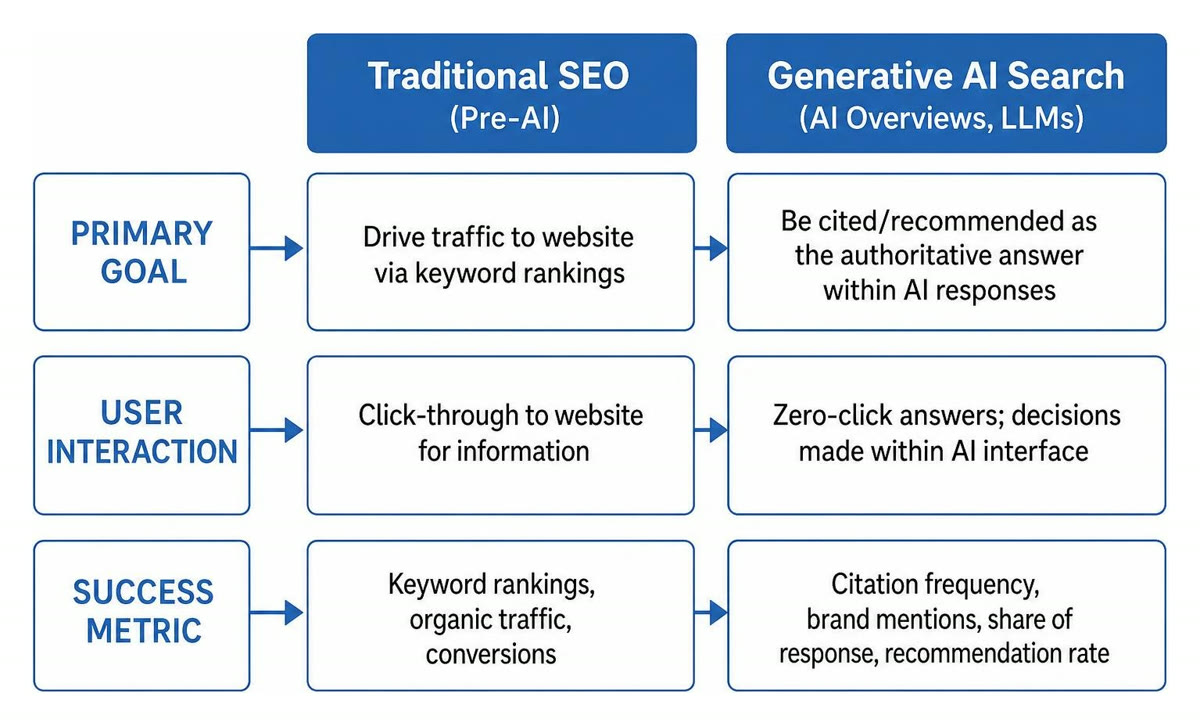
The architectural shift from traditional keyword-based search to generative AI search is profound. While traditional SEO focused on driving clicks to our websites by ranking for specific keywords, AI search prioritizes synthesizing answers directly within the AI interface. This leads to a significant increase in zero-click interactions, where users receive information without ever visiting our site. Our goal transitions from being found in a list of links to being cited as the authoritative answer.
Here’s a comparison highlighting the key differences:
Feature Traditional SEO (Pre-AI) Generative AI Search (AI Overviews, LLMs) Primary Goal Drive traffic to website via keyword rankings Be cited/recommended as the authoritative answer within AI responses User Interaction Click-through to website for information Zero-click answers; decisions made within AI interface Success Metric Keyword rankings, organic traffic, conversions Citation frequency, brand mentions, share of response, recommendation rate Content Focus Keyword-rich pages, backlinks, technical crawlability Semantic depth, factual density, structured data, entity consistency Output Format List of ranked web pages (SERP) Synthesized answers, conversational responses, AI Overviews Crawler Behavior Indexing pages for relevance to keywords Ingesting content for understanding, summarization, and citation Attribution Direct website visits, last-click models Assisted conversions, upstream AI mentions, brand awareness, sentiment This “great decoupling” of visibility from direct clicks means that while our content might appear at the top of an AI Overview, the user may never visit our site. However, this pre-click visibility is invaluable for brand awareness and influencing downstream conversions.
Optimizing Content Architecture for AI Search and Brand Strategy
To thrive in this new environment, our content architecture must be designed for machine readability and extractability. This is where Answer Engine Optimization (AEO) and Generative Engine Optimization (GEO) come into play, distinct yet complementary to traditional SEO. AEO focuses on structuring content so AI can easily understand and use it to answer direct questions, while GEO specifically targets generative engines like ChatGPT, Gemini, and Perplexity.

Implementing these strategies involves:
- Semantic Depth: Moving beyond keywords to comprehensively cover topics, answering user questions directly and thoroughly.
- Modular Formatting: Using short, concise paragraphs (50-100 words), bullet points, numbered lists, and clear headings (e.g., question-based H2s and H3s) that AI can easily extract.
- Factual Density: Ensuring content is rich in verified facts, data, and evidence, making it a reliable source for AI systems.
- Structured Data (Schema Markup): Using JSON-LD to explicitly label elements like FAQs, products, organizations, and articles. This provides AI with a clear understanding of our content’s context and relevance. For example, implementing FAQPage a schema can directly feed into AI Overviews.
- llms.txt: This emerging standard, similar to robots.txt, signals to AI systems, signals to AI systems which parts of our site are intended for LLM consumption, guiding them to our most authoritative content.
- Technical Accessibility: Ensuring our site has clean HTML, fast load times, and is easily crawlable by AI bots. This foundational work is crucial, and specialized services, such as generative AI SEO services, can be instrumental in auditing and optimizing our digital presence to meet these new requirements.
By adopting an “answer-first, explain-second” approach, we empower AI systems to cite our brand accurately and authoritatively.
Establishing Entity Authority in AI Search and Brand Strategy
In the AI era, brand authority is paramount. AI systems prioritize sources that demonstrate Experience, Expertise, Authoritativeness, and Trustworthiness (E-E-A-T). This means building a robust digital footprint where our brand’s “entity” – its identity, products, services, and values – is consistently defined and reinforced across all online touchpoints.
- Entity Consistency: Our brand name, mission, and key offerings must be presented uniformly across our website, social media profiles, third-party listings, and press mentions. This helps AI systems build a clear, unambiguous knowledge graph of our brand.
- Topical Authority: We must establish ourselves as a go-to source for specific topics by creating comprehensive, high-quality content clusters. This signals to AI that we possess deep expertise in our niche.
- Third-Party Consensus: AI models value consensus. Earning citations and mentions from reputable industry publications, academic institutions, and trusted news outlets significantly boosts our perceived authority.
- Brand DNA Articulation: Our unique brand story, values, and differentiation must be woven into our content in a way that is both human-centric and machine-readable. This ensures that when AI synthesizes an answer, it accurately reflects our desired narrative.
Staying abreast of the latest strategies for building this kind of authority can be challenging, but resources like a dedicated brand strategy newsletter can provide invaluable insights and keep us informed on evolving best practices. By focusing on E-E-A-T and consistent entity signals, we can build a strong foundation of trust with AI systems, increasing our likelihood of being cited as a preferred source.
Measuring Impact, Creator Authority, and Strategic Governance
The shift to AI search necessitates a complete re-evaluation of how we measure marketing success. Traditional metrics like click-through rates, while still relevant, no longer tell the full story. We need new frameworks to understand our brand’s visibility and influence within AI-mediated discovery journeys. This requires strategic governance to ensure our efforts are aligned, machine readability is prioritized, and we can track impact across the entire funnel.

The Role of Creators and Earned Citations in Generative Engines
Creators and influencers play an increasingly vital role in building brand visibility in AI search. Their authentic, publicly accessible content is a rich source of information for LLMs. Many brands are now incorporating “AI visibility” into creator briefs, understanding that creator content can directly influence AI-generated answers.
Here are steps for auditing creator content for generative visibility:
- Identify LLM-Cited Creators: Analyze which creators or influencers are already being cited by AI models when discussing topics relevant to your brand or industry. Focus on those who rank in LLM results, not just those with high social media volume.
- Audit Content for Machine Readability: Review creator content for clear, concise, and factual information. Are their captions machine-readable? Do they use structured formats like bullet points or direct answers?
- Track Citation Impact: Monitor how often and in what context creator content is cited by AI systems. This goes beyond traditional engagement metrics to measure actual influence on AI answers.
- Strategic Placement: Encourage creators to produce content that is positioned correctly for AI ingestion. High volume without strategic placement may not be indexed effectively by AI engines.
- Leverage Authentic User-Generated Content (UGC): AI systems often draw from authentic discussions and reviews. Fostering genuine UGC can organically boost citation authority.
- Amplify External Citations: Collaborate with creators, journalists, and third-party media to generate earned citations. These external validations are powerful trust signals for AI.
This new dimension of creator marketing requires a collaborative approach, often partnering with SEO teams to reverse-engineer the “Google Engine Optimization” (GEO) process for tracking creator influence.
Metrics, Measurement Frameworks, and Attribution Beyond the Click
Measuring success in AI search requires a new set of key performance indicators (KPIs) and attribution models. Since many AI interactions are zero-click, we must look beyond direct website traffic to understand our brand’s impact.
Key metrics and measurement frameworks include:
- Share of Response (SoR): This quantifies how often our brand is mentioned or recommended in AI-generated answers compared to competitors. It’s a critical indicator of category ownership.
- Brand Mentions & Citation Tracking: Monitoring the frequency and quality of our brand’s appearance in AI responses, distinguishing between a general mention and a direct citation with a source.
- Recommendation Rate: Tracking how often AI systems explicitly recommend our brand or products in response to user queries.
- Sentiment Scoring: Analyzing the sentiment (positive, negative, neutral) associated with our brand in AI-generated answers.
- Prompt Monitoring: Actively tracking the types of prompts users are entering into AI systems and how our brand responds to them.
- Assisted Conversions: Expanding our attribution models to recognize the upstream influence of AI mentions on later conversions, even if there’s no direct click from the AI interface.
- AEO Analytics: Utilizing specialized tools that provide insights into AI impressions, brand mentions, and entity health within AI environments.
- Downstream Branded Search: A rise in branded search queries after an AI interaction can indicate successful AI-driven brand awareness.
These new metrics, combined with traditional business KPIs like sales and return on ad spend (ROAS), provide a more holistic view of our brand’s performance in the AI era.
Navigating Over-Optimization Risks and Preparing for the Future
While optimizing for AI search is crucial, there are risks associated with over-optimization. Excessive focus on machine readability without genuine value can lead to “AI slop” – generic, uninspired content that lacks human appeal and ultimately dilutes our brand message. The goal is always to write for humans first, with AI in mind.
To prepare for the future, brands must embrace:
- Continuous Iteration: The AI landscape is rapidly evolving. Our strategies, content, and measurement frameworks must be agile and adapt through continuous testing and learning.
- Agentic Discovery: As AI systems become more autonomous, they will increasingly make purchase decisions or recommendations on behalf of users. Our brand needs to be positioned as the preferred choice for these “consumer-for-the-consumer” models.
- Multi-Modal Search: The future of AI search will integrate text, voice, images, and video. Our content strategy must expand to encompass these diverse formats, ensuring our brand is discoverable across all modalities.
By understanding the nuances of AI search, strategically optimizing our content, building robust entity authority, and adapting our measurement frameworks, we can ensure our brand remains visible, relevant, and influential in this exciting new chapter of digital discovery.