
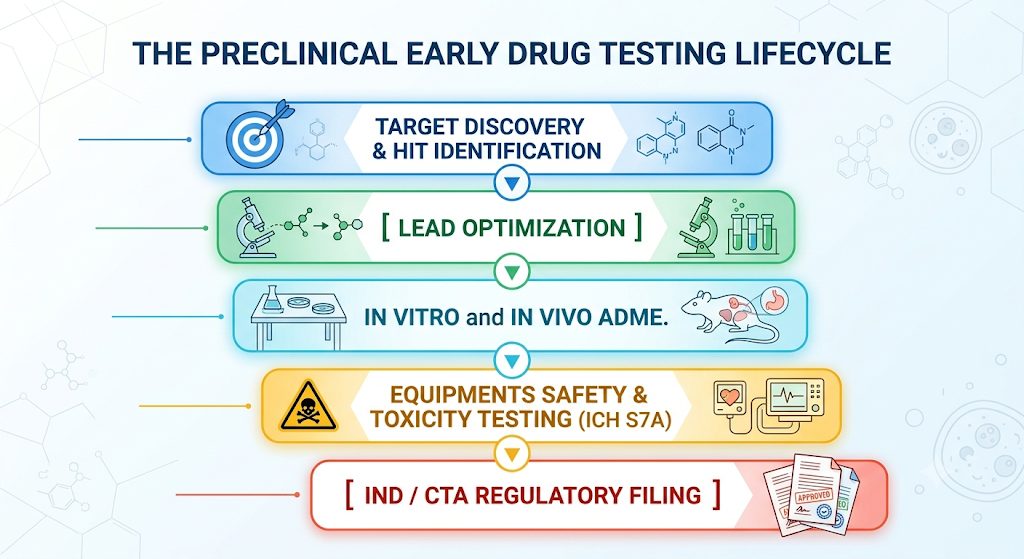
Preclinical early drug testing converts initial chemical compounds into safe and regulatory-approved drug candidates for human clinical trials that are subjected to a series of in vitro studies, ADME studies, and GLP-compliant toxicological studies. This one helps to reduce any systemic risks prior to the start of clinical trials.
Collaborating with apreclinical UK CRO with experience ensures compliance and significantly helps to reduce developmental failure.
Target Identification to Hit Discovery
Identifying a biological target is the first stage in the preclinical path, where the target is seen as a particular protein, gene, or pathway present in cells and connected to a disease condition. High-throughput screening (HTS) is carried out to scan through many compounds or biologics in a library, looking for “hits.”
Structural biology combined with modern target validation can reduce the number of non-viable compounds by more than 40% in the early stages of selection, according to a study in the repository of Nature Reviews Drug Discovery. After hits have been shown to interact with the biological target, chemical structures are further optimized in lead optimization. Chemical groups of drugs are manipulated by medicinal chemists to improve binding affinity, selectivity, and metabolic stability.
ADME Profiling and Pharmacokinetics
Researchers need to determine the ability of biological systems to process the molecule before exposing molecules to safety pharmacology. ADME profiling offers quantitative measures on four important axes:
- Absorption: The effectiveness with which the compound is transferred to systemic circulation from the place it was given.
- Distribution: Pattern of distribution, permeability of the blood-brain barrier, and plasma protein binding.
- Metabolism: Enzymatic conversion (predominantly due to cytochrome P450 in liver cells) and the identification of any possible toxic metabolites.
- Excretion: The rate of clearance and excretion processes (through renal and biliary pathways).
According to data collected by the European Medicines Agency (EMA), faulty pharmacokinetic characteristics may account for up to 50% of therapeutic failures in early development phases. Early ADME studies optimize the therapeutic dose range and prevent late-phase failure.
GLP Toxicology and Safety Assessments
Safety studies move applicants from an exploratory biology phase to a strict testing regime that is conducted under Good Laboratory Practice (GLP) standards. ICH guidelines are drawn up and enforced by regulatory agencies like the Medicines and Healthcare products Regulatory Agency (MHRA).
|
Test Category |
Primary Objective |
Standard Duration / Guideline |
|
Safety Pharmacology |
Assesses the function of important organs (Cardiovascular, CNS, Respiratory) |
This is the core battery, found in the ICH S7A / S7B. |
|
Acute Toxicity |
Determines the maximum tolerated dose (MTD) and single-dose toxicity |
14 Days |
|
Repeat-Dose Toxicity |
Evaluates organ-specific toxicity and cumulative effects in different species |
28 to 90 Days |
|
Genotoxicity |
Risk associated with gene mutation or chromosome breakage |
Bacterial Reverse Mutation (Ames Test) + In Vitro Cytogenetics |
The above-mentioned GLP-compliant study results give us the NOAEL, which is considered the starting point for human dose calculation for the beginning of Phase I.
Navigating Regulatory Approval for Clinical Entry
Finally, all the information is collected into the full dossier for either IND submission to the FDA in the USA or CTA submission in Europe and the UK.
A complete dossier comprises Chemistry, Manufacturing & Control (CMC) Data and all in vitro & in vivo, ADME and GLP Toxicity Data. The above-mentioned dossier undergoes rigorous analysis by regulatory agencies to maintain safety margins before clinical trials in humans. An expert preclinical UK CRO means that every study meets the ICH and GLP standards applicable to studies conducted in the international arena.
Streamlining Your Path to Clinical Success
Bringing those early chemical hits to the clinic, with clear strategic execution, strict GLP compliance, and rigorous toxicity validation. Biopharmaceutical developers can reduce risk, preserve capital, and hasten timelines to clinical trials by setting early NOAEL baselines, with complete ADME profiles.